
Blog
Shockwave therapy for an ankle sprain that hasn't settled
Reviewed by Dr Voula Roumel, Chiropractor , registered since 1987, AHPRA CHI0000942872
Published
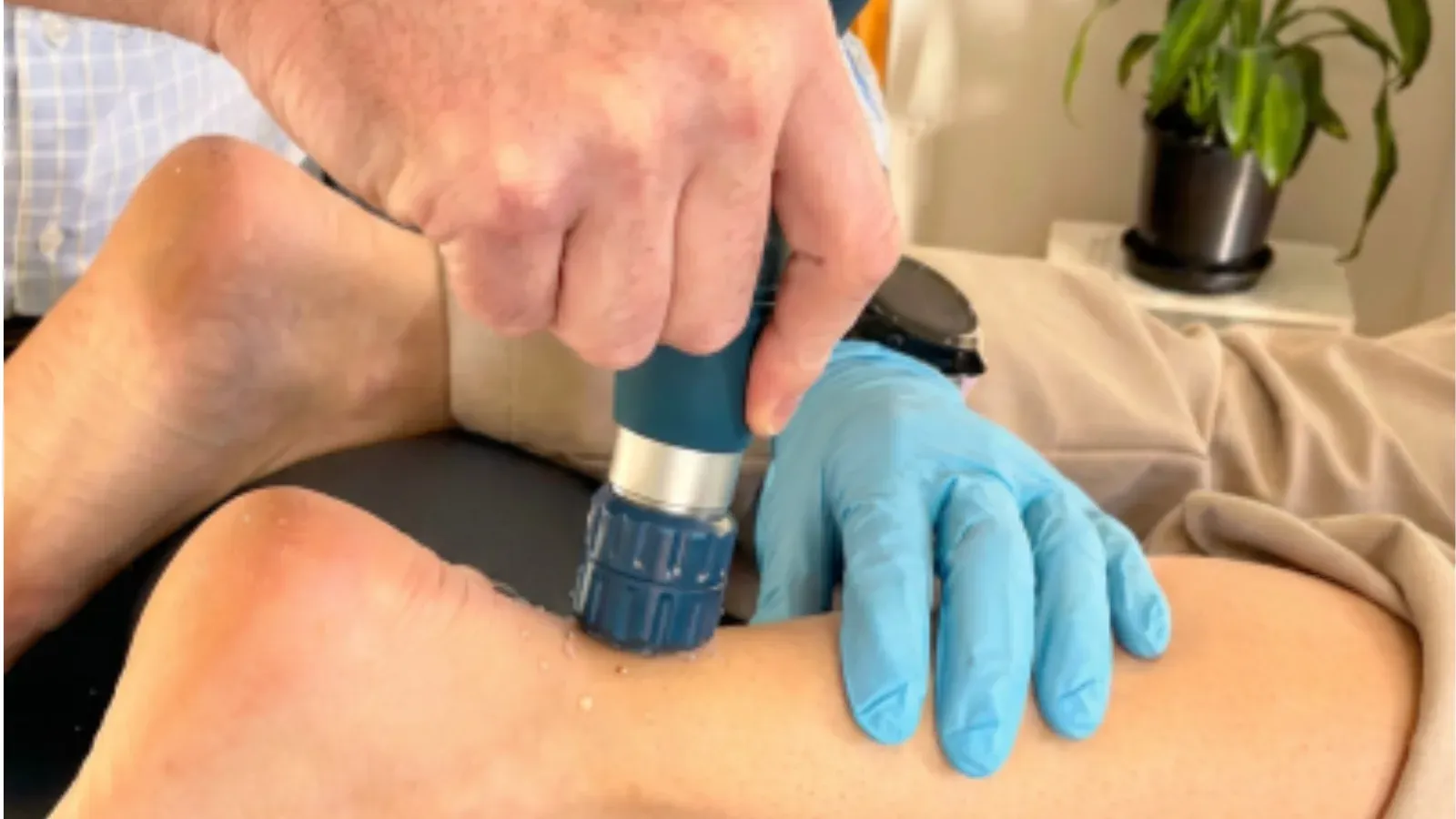
Most ankle sprains settle on their own timeline with sensible loading. The one worth writing about is the other kind: the ankle that has its range back, passes the basic tests, looks fine walking, and still will not tolerate running, changing direction or a full session months after the injury.
That gap is where shockwave therapy has a job. It is used here for long-standing tendon and fascia presentations that have not settled with hands-on treatment and loading work, and a stalled ankle is one of the ways that shows up.
Where it fits in an ankle rehab
Rehabilitation tends to stall at a particular point. Basic function has returned, strength and mobility have improved, and tolerance to dynamic or repetitive load has not caught up. At that stage the limiter is usually pain rather than strength or motivation, and pain is what stops the running volume, the speed and the sport-specific work from going up.
Shockwave is aimed at that specific problem. Used well, it helps modulate pain and tissue sensitivity so that loading can progress, which matters most in the transitions that ask the most of an ankle: running progression, change of direction, deceleration drills.
Three things it is used to do, and they are all about the rehab rather than the ankle on its own:
- Reduce the pain that is limiting exercise progression
- Support gradual re-exposure to mechanical load
- Keep momentum through the higher-demand phases of recovery
That is also the honest limit of it. Shockwave does not replace rehabilitation. Its value is in supporting tissue while it adapts to demand that is being deliberately increased.
What the pulses actually do
The handpiece delivers rapid acoustic pressure waves into a defined area of tissue. That produces a mechanical stimulus, and tissue responds to mechanical stimulus biologically, through a process called mechanotransduction. It is the same principle behind why loading a tendon changes it, delivered by a different route.
The mechanism has been reviewed reasonably well. d’Agostino and colleagues described shockwave in International Journal of Surgery in 2015 as a mechanical stimulus that recruits a healing response; Romeo and colleagues, in a Medical Principles and Practice review the year before, described low-intensity shockwave prompting macrophages and stem cells to migrate towards damaged tissue. Rhim and colleagues looked at its use with in-season athletes in Healthcare in 2023, where the practical appeal is that it is non-invasive and leaves almost nothing to recover from afterwards.
Worth reading those for what they are: descriptions of a mechanism and its clinical use, not a promise about your ankle.
Focused and radial: two ways of delivering it
Therapeutic shockwave collects a confusing number of names — ESWT, FSW, RSW, EPAT, acoustic wave therapy. Underneath the labels there are two technologies, and they differ in how the energy gets into tissue.
| Focused shockwave | Radial shockwave | |
|---|---|---|
| How the wave is made | A small discharge inside the applicator, focused through a lens | A projectile driven ballistically by compressed air or an electromagnetic field onto a transmitter |
| Where the energy goes | Concentrated at a chosen depth | Spreads outward from the skin, strongest nearer the surface |
| Measured in | Millijoules per square millimetre | Bar |
| Suits | A well-defined target, superficial or deep | Diffuse pain or sensitivity across a larger area |
Radial is the more common of the two worldwide, largely because the devices cost less. Focused allows a specific energy level to be set at a specific depth.
Neither is better than the other, and selection is not a question of superiority. It follows the presentation, how deep the tissue sits and what the person in front of you can tolerate. Ask which is being used on you and why, at the assessment.
What a session involves
Gel over the area, then the handpiece worked across it for 10 to 15 minutes. You will feel rapid tapping, firm and somewhat uncomfortable over the tender spot. Most people find it tolerable rather than painful, and intensity is adjusted during the session from what you say.
It is a course rather than a single treatment, spaced about a week apart. The response builds over the following weeks rather than arriving immediately, which is worth knowing so a quiet first fortnight is not mistaken for failure. Some soreness for a day or two afterwards is normal.
What it costs
$78 a session, item code 1005. It is booked as a returning-patient appointment, because the assessment that decides whether shockwave is appropriate comes first. The full list is on the fees and health rebates page; quote the item code to your fund and they will tell you what your policy pays, and the rebate itself comes off through HICAPS on the day.
Why it is not the whole treatment
Shockwave is a stimulus applied to tissue. What decides whether that tissue can then handle a Saturday game is the loading programme, which is why it is used alongside rather than instead of the rest of the work:
- Rehabilitation exercises for strength, balance and the control the ankle lost — the durable part
- Massage therapy through the calf and surrounding musculature
- Chiropractic adjustment where restriction further up the chain is changing how the ankle is loaded
- A conversation about training volume, surfaces and footwear for the period it takes to settle
The same reasoning applies to the neighbouring presentations it comes up for most: Achilles pain and plantar fasciitis that have not responded to loading work. A sports chiropractor appointment is where an ankle that keeps failing at the same point gets looked at properly.
Who it isn’t for
The chiropractor screens before offering it. Shockwave is not used:
- Over an active infection, a tumour, or an open wound
- Over growth plates in children
- For anyone taking blood thinners or with a bleeding or clotting disorder
- In pregnancy, over the relevant regions
Tell the chiropractor about your health history and any medication you take. That conversation happens before shockwave is offered, not after.
One thing to sort out first: an ankle you cannot stand on, or one that is still sharply tender over the bone weeks later, needs imaging before any of this. That is a referral your chiropractor writes at the assessment.
Getting it looked at
If your ankle has been improving and then stopped, that plateau is the thing to bring in, not the original sprain. Book a first appointment and you will get the findings and your options before anything is decided, including whether shockwave has any part in it. Most ankles never need it.
More articles
Frequently asked questions
Can shockwave be used straight after a sprained ankle?
No. It is not an acute treatment and it is not where care starts. Shockwave is used later, on the presentations that have stopped improving with hands-on treatment and loading work, which is a specific situation rather than a first move. A fresh sprain is assessed, settled and loaded first, and most never need shockwave at all.
Does shockwave therapy hurt?
It feels like rapid tapping against the skin, firm and a little uncomfortable over the tender area. Most people describe it as tolerable rather than painful. Intensity is adjusted during the session from what you report, so tell the chiropractor if it is too much. Some soreness for a day or two afterwards is normal and expected.
How many sessions does it take?
It is a course rather than a single treatment, typically spaced about a week apart, and the response builds over the weeks that follow rather than showing up immediately. The chiropractor will tell you after the assessment how many they expect. If there is no change at all by the point they expected one, that is a reason to reassess rather than book more.
What is the difference between focused and radial shockwave?
Focused shockwave concentrates its energy at a set depth and is measured in millijoules per square millimetre. Radial shockwave is generated ballistically, spreads out from the skin and is strongest nearer the surface, and is measured in bar. Neither is better than the other. Which suits a presentation depends on the tissue, its depth and what you can tolerate.
How much is a shockwave session?
$78 a session, item code 1005, with 10 to 15 minutes of treatment time. It is booked as a returning-patient appointment, so an assessment comes first. Quote the item code to your fund and they will tell you what your policy pays.
Do I still need to do the exercises?
Yes, and this is the part people most want to skip. Shockwave is a stimulus applied to tissue; the loading programme is what builds that tissue's capacity to handle what you are asking of it. An ankle treated with shockwave and then returned unchanged to the load that irritated it will irritate again.
Ready to book?
Appointments Monday to Saturday, with confirmation by SMS.